
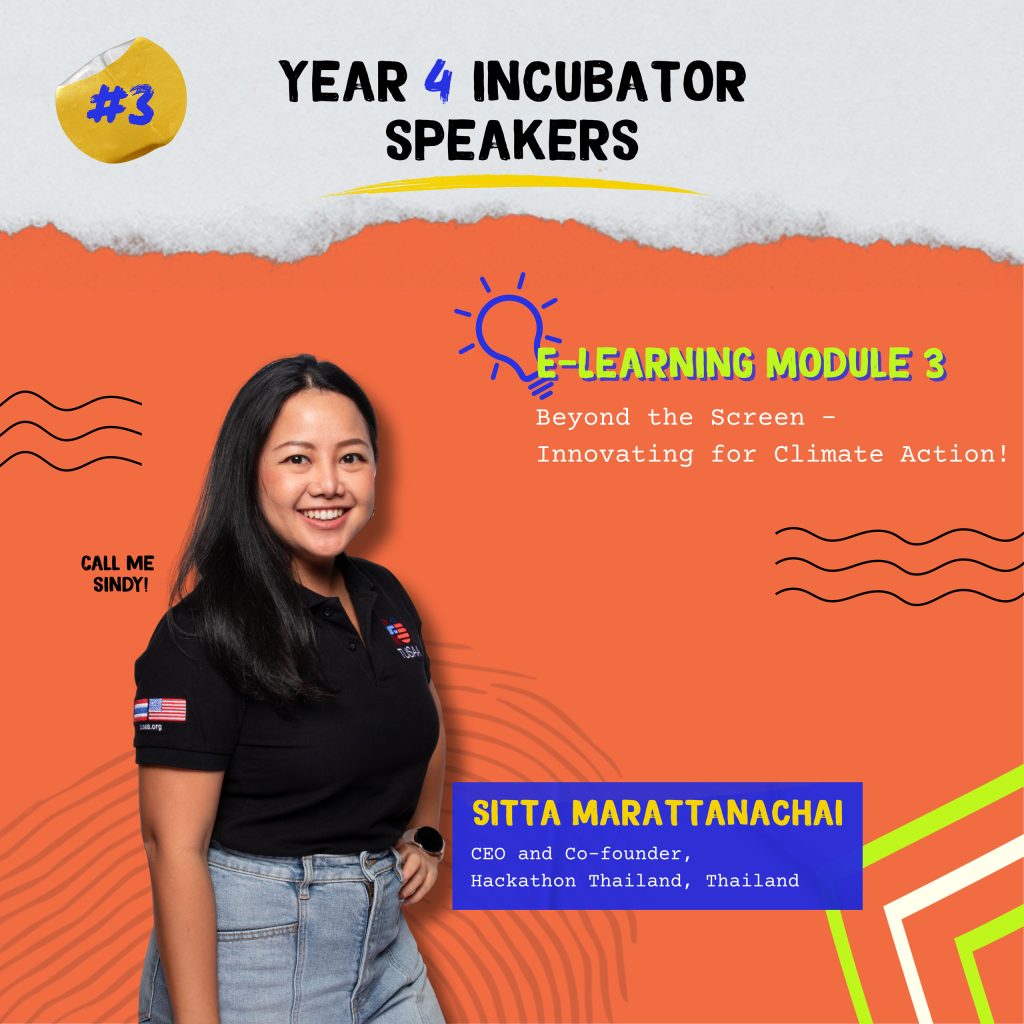
You’ve crafted your message and built your story. Now it’s time to take your campaign beyond the screen.
In this final module, you’ll be challenged to think bigger, bolder, and more creatively about the real-world impact of your work. It’s about moving from awareness to action exploring tangible, scalable solutions that address climate challenges at the ground level.
To guide you, we’re joined by Sitta (Sindy) Marattanachai, an environmental engineer, climate innovation strategist, and co-founder of Hackathon Thailand. With over a decade of experience designing sustainability programs across Asia-Pacific, Sitta is passionate about turning ideas into action especially when it comes to youth-driven innovation and grassroots solutions.
Get ready to ideate, prototype, and reimagine what’s possible beyond the scroll, beyond the screen.
Module Description:
In this final module, you’ll take the bold step from online awareness to real-world action. Led by engineer and climate innovation strategist Sitta (Sindy) Marattanachai, this session invites you to reimagine your campaign as a platform for offline engagement, through prototypes, partnerships, and community-led solutions.You’ll explore systems thinking, identify root causes, and learn how to create small but powerful real-life interventions. Whether it’s a community event, a low-cost toolkit, or a quick prototype to test an idea, this module empowers you to move from storytelling to system-hacking.
Learning Objectives:
By the end of this module, you will:
- Understand how to translate digital campaigns into offline action that engages your audience.
- Apply systems thinking tools (like the Iceberg Model and Triple-A Mapping) to uncover root causes behind sustainability challenges.
- Learn how to develop simple prototypes to test your ideas and invite community feedback.
- Gain practical steps for community engagement planning, from identifying stakeholders to gathering resources.
- Embrace failure as part of innovation, and use feedback to iterate and improve.
Key Takeaways:
- Innovation doesn’t require perfection or funding, it starts with curiosity, courage, and small steps.
- Systems change begins when ideas meet people in the real world.
- A prototype can be anything: a flyer, a conversation, a pop-up booth, as long as it invites feedback and participation.
- Use tools like the Iceberg Model and Triple-A (Authority, Ability, Acceptance) to guide your strategy.
- Your first community is already around you: friends, classmates, neighbors, people who care and can help test your idea.